
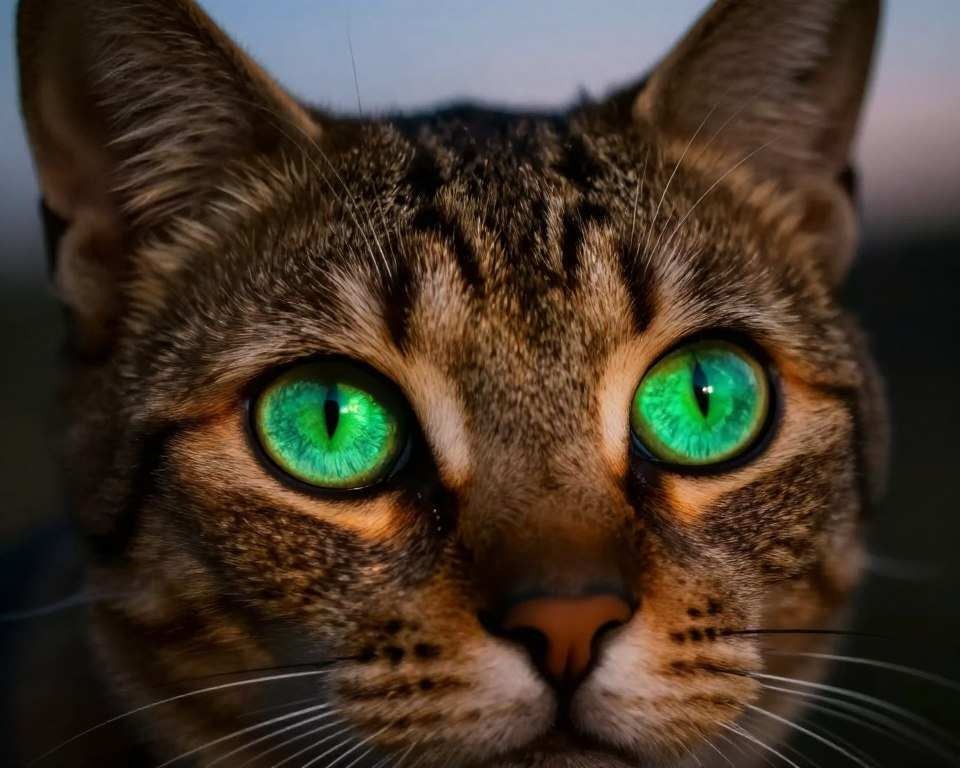
Over the years many cat owners are convinced that their furry companions can easily move through the darkness. This has shed some light and debate on whether the ability to see completely in the dark is a unique ability to cat vision, or is it a myth.
Can cats see in the dark? Part of the reason many people believe that cats can see in the dark is the construction of a cat’s eye and the reflective layer that enhances their vision in the low light condition. This has led many to believe that cats truly do possess some form of night vision.
Key Takeaways
- Cat’s vision is more adapted to seeing in low light than bright light.
- The tapetum lucidum tissue is a main reason why many people believe it enhances night vision in cats.
- Cat owners can be seen watching their cats roam around in the night.
There is a dark and complex art which explains the theory around cat’s vision and is a tribute to the knowledge which is richly complex and elegantly deep.
This knowledge will also further aid in helping people admire the cat’s in greater detail.
Feline Vision Hard Science
Feline vision has always been an interesting area of study as cats have the ability to see, navigate, and hunt in low-light conditions and their vision works in an area where human vision has impaired functioning. Cats have fascinating eyes which are capable of capturing and processing light optimally while the human vision has much poorer functioning.
Click On Read: – Bird and House
Structure of Cat’s Eye
Cat’s eyes have a completely different structure than human eyes. Numerous components explain their ability to see better in low light conditions than humans. The retina has a much larger number of rods which are the light-sensitive cells in the equal structures and are capable of differentiating and sensing movements in low lit environments. The retina has a reflective tapetum lucidum which captures light and reflects it back to give the photoreceptors a second chance to absorb the light.
How Cats Process Visual Information
Unlike humans, can cats see in the dark focus more on light, motion, and detail, rather than color and fine detail. This is influenced by the construction of their eyes, which are designed to be more sensitive to lower light levels and motion. When light signals are sent to the brain from the eyes, the brain prioritizes the information that is most relevant to the cat’s survival. This helps the cat develop a mental picture of the environment that helps them hunt.
Knowing more about a cat’s exceptional ability to see and the science that explains it helps cat owners appreciate and understand how to meet cat’s visual needs.
Do Cats Actually See In The Dark?
The ability to navigate and hunt is a trait cats possess and is the reason they are given this ‘superior’ night vision. What really is superior night vision?
What Night Vision is
There are several adaptations in a cat’s eye that help it see in low lit environments. It is a common misconception that cats can see in total darkness. The correct definition of night vision for cats is that they see better than humans in dark environments.
How Well Cats See
Cats are generally thought to see well in the dark and this is due to several physiological adaptations of their eyes. They are better at seeing due to a reflective layer called the tapetum lucidum. This gives the photoreceptors more light to read.
Another adaptable feature is how wide they can open their pupils.
There are noticeable differences when comparing human vision to that of cats in terms of low-light conditions.
Visual Ability Humans Cats
Low Light Sensitivity Limited High
Pupil Size Moderate Very Large
Presence of Tapetum Lucidum No Yes
Misconception: Cats Can See in Total Darkness
One of the most common misconceptions of cats is that they can see in total darkness. Dr. Bruce Kornreich, can cats see in the dark director of the Cornell Feline Health Center, states that “Cats can’t see in total darkness, but they can see much better in low light than humans.” This illustrates that while cats may see better than humans in low light, they are still subject to the same limitations that humans are when it comes to seeing in the dark.
Cat vs. Human Vision: A Comparison
The differences between cat vision and human vision can explain why it is so easy for cats to see in the dark; humans and cats have fully developed unique visual systems that better cater to the needs of each species.
Variations in Light Sensitivity
Cats’ remarkable and well-known ability to see in low-light situations is due to the structure of their eyes, which possess a reflective layer, known as a tapetum lucidum, that improves their capacity to capture and utilize light. Unlike cats, humans possess a greater number of cone cells in their retinas that aid in color vision and sharp detail vision in bright light.
As noted by Animal vision specialists: “The feline eye is optimized for low light conditions, making them adept hunters during dawn and dusk when prey is most active.” This adaptation is crucial for their survival and highlights the significant difference in light sensitivity between cats and humans.
Variations in Color Vision
While humans perceive the world as bold and colorful, cats’ vision is far more muted. This is primarily due to the number of cone cells present in the eye. Humans have trichromatic vision, meaning that there are three types of cone cells present in the retina. Each of which possess a sensitivity to different light wavelengths and work in unison to provide a broad spectrum of color. Cats, on the other hand, possess only two cone cells and thus have a more restricted spectrum in vision.
Visual Characteristics: Human and Cat Vision
Cat and human vision has a few similarities and differences. The most notable differences are color perception, light sensitivity, and motion detection.
Visual Aspect Human Vision Cat Vision
Color Perception Trichromatic (wide range of colors) Dichromatic (limited color range)
Light Sensitivity Less sensitive to low light Highly sensitive to low light
Motion Detection Good but limited by light Excellent, even in low light
Field of View and Motion Detection
Can cats see in the dark have a larger field of vision than humans, having nearly a 200-degree field of view compared to a human’s 180 degrees. This, coupled with their excellent motion detection, allows them to quickly respond to movement in their peripheral vision.
Evolutionary Adaptations for Night Vision in Cats
Like many of their traits, the ability of cats to see in the dark comes from many different evolutionary pressures. Cats have always been able to see and hunt in the dark from their evolution of different traits. This is not the result of one trait. It is a combination of many different traits that have come together to help them see in the dark.
The Tapetum Lucidum: Nature’s Light Amplifier
It acts like a mirror, reflecting some of the light that passes the retina back onto the light receptors, thereby increasing the available light. As Dr. John Smith, an expert on the vision of cats, states, “The tapetum lucidum is a very important part of a cat’s night vision because it helps them see even the smallest amount of light.”
Pupil Shape and Light Control
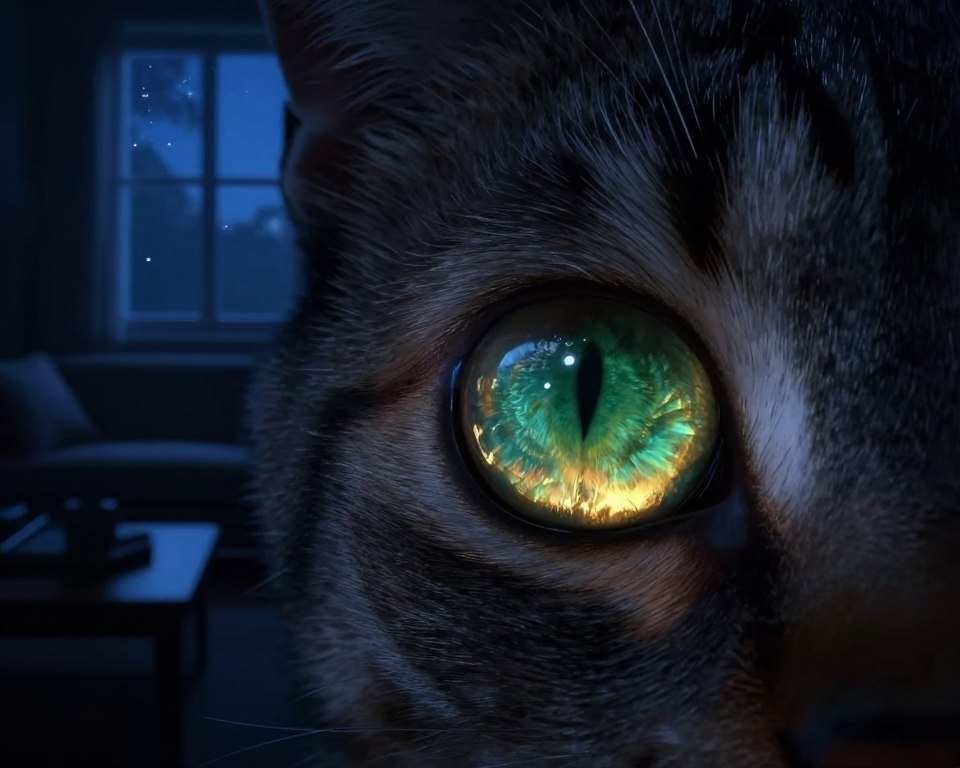
A very important component of night vision is the anatomy of a cat’s eye, specifically the shape of a cat’s pupil. Can cats see in the dark possess vertically-aligned pupils that can open very wide, allowing them to take in much light. This adaptability is very important for their survival in the wild. As noted in a study on the anatomy of cats “The vertically-aligned pupil is an evolutionary adaptation to low light hunting and provides ample light to the cat’s eye.”.
To sum up, cats’ evolutionary adaptations are anchored in how complex and different syntactically their adaptations are to folds to interact with the very light and adaptively respond to the different attributes of light. Their very flexible foldable tapeta, their unique pupil adaptations, and the different configurations of the guides make them together, the flexible adaptively responding to the different light guides. Together, they make cats more adaptive to flexible folds to interact with the very light attributes.
Considerations for Cat Owners
It is a main evolutionary trait of a cat to optimize its vision. A cat’s unique trait is to see with fine detail in low light situations.
Most cat owners are unaware that cats are able to see and chase prey in the dark. Understanding these attributes can assist the cat owner in making adjustments to the home in order to provide a fortifying residence for their cats. Understanding these attributes can assist the cat owner in making adjustments to the home in order to provide a fortifying residence for their cats.
The benefits for cat owners are evident: Understanding the visual world of cats can help owners comprehend the needs and behaviors of their pets. Cat owners willing to enrich their relationships with their pets can use this knowledge to improve their intrinsic understanding of cat vision and the role it plays in day-to-day interactions. Cat owners can enhance their awareness of a cat’s environment and modify the lighting in a room to better suit a cat’s vision.
Understanding the way that cats see and interact with the world around them will empower cat owners to make positive changes that will improve their pet’s quality of life and, consequently, strengthen the bond between the cat and the owner.
FAQ
What Allows Cats To See In Low Light?
In the back of a cat’s eyes, there is a specialized reflective layer called the tapetum lucidum, that reflects light back onto the retina. This structure allows cats to see better than humans under low light conditions.
Can Cats Vert Completely Dark Conditions?
Cats are not able to see in total darkness, although they are better equipped than humans for seeing in low light. They still rely on some amount of light in order to see.
How Does A Cat’s Vision Compare to Human Vision?
Humans and cats perceive vision differently on a few different spectrums. Cats possess better vision than humans when in low light, in detecting motion, and when seeing in the overall dark, however, humans have better acuity and perception than cats.
What Does Tapetum Lucidum Do for A Cat’s Vision?
This reflective layer of tissue helps in the perception of light, allowing cats to see better in low light conditions.
Do Dogs Or Cats Have Better Night Vision?
Cats possess better night vision than dogs, attributed to the size of their pupils and reflective tissue in the back of their eyes.
Can Cats See Colors Like Humans?
No, cats possess a lower range of color perception than the average human.
What is the impact of a cat’s pupil shape on their vision?
A cat’s pupil shape gives them more ability to control how much light comes into their eyes, which aids in adjusting to varying light conditions. Do cat vision misconceptions exist?
There is a misconception that cats can see in total darkness. They have good night vision, but they still need a little light in order to see.